
An ETF website is the only marketing item that is also a regulatory requirement
If you’re launching an ETF, your website is not just a marketing tool; it’s a compliance requirement. You need a website that meets compliance regulations, but you also don’t want to be stuck with an overly simplified site because you were in a rush. Ideally, ETF issuers should begin website planning four months before launch. Here, we’ll explore what’s necessary at launch vs. what would be nice to have, and lay out a realistic timeline to have the website that’s right for your funds ready by launch day.
On launch day, your ETF website must be live and ready to populate the SEC’s 6c-11 mandated data after market close. Because this must be done daily, you’ll need to automate this data in advance. Setting up automation takes time; this is why it’s important to work with a website provider that is familiar with ETFs, and to consider your website build early in your ETF launch planning process.
The Requirements
Data
For ETFs relying on Rule 6c-11, the SEC requires certain information to be disclosed publicly and prominently on the fund’s website. This includes:
- Daily portfolio holdings – Holdings as of the end of the prior business day, including CUSIPs or other identifiers
- NAV, market price, and premium/discount – As of the end of the prior business day
- Premium/discount history – Shown as both a table and a line graph, covering the most recent calendar year and calendar quarter
- 30-day median bid-ask spread – A rolling figure calculated using the national best bid and offer (NBBO)
Fund documents
Document requirements are required to be displayed on your website:
- Prospectus (and summary prospectus, if used) and Statement of Additional Information
- Annual and semi-annual shareholder reports
- Fund fact sheet (this is not required by legal, but expected)
- Tax information, such as year-end tax characterizations when available (this is not required by law, but expected)
Site-wide requirements
- Legal and disclosure footer: disclaimers, risk language, and distributor information
- Privacy policy, terms of use, and accessibility statement
- All marketing copy must be reviewed by compliance before publishing
- Contact and investor-service information
Fund page essentials
Here is a list of some of the common things many ETF websites have. They are not legally required, but are industry standard:
- Ticker, exchange, CUSIP, inception date, and expense ratio
- Investment objective and strategy in plain language, consistent with the prospectus
- Standardized performance with required disclosures, once there is a track record
- Top holdings plus the full downloadable holdings file
- Risk disclosures placed near any performance or marketing content
- Distribution history
- Links to the documents library
Nice to Have
These help distribution but should not delay launch:
- Insights, commentary, and thought leadership
- In the News page
- FAQ page
- Advisor resources and sales materials
- Comparison tools and calculators
- Email capture and newsletter signup
- Where-to-buy information
- Analytics and SEO optimization
- Video
When to start preparing
Because today’s technology can help individuals build a website almost instantly, ETF issuers don’t always think of the website as a heavy lift. This is a common misconception and can delay your fund launch. So what takes so long?
- ETF Websites are often custom CMS rather than ready-to-build platforms. The two main reasons are security and data delivery – custom CMS is generally more secure and is capable of handling multiple complex data feeds. Coding takes time.
- Your website launch is dependent on outside factors. The biggest two are data feeds from service providers and compliance review. Your website provider should work directly with your data provider to build data delivery systems via FTP or API. You will need to work with your compliance provider to ensure they have time to review your website before launch.
- Internal Delays. Internal disagreement or busy schedules that keep your company stakeholders from meeting to review and revise deliverables from your website provider can slow down your build significantly. Keep your website team small, decisive, and not overwhelmed with other responsibilities.
Here is a realistic timeline for a website of moderate size and sophistication, including what is happening between you and your website provider:
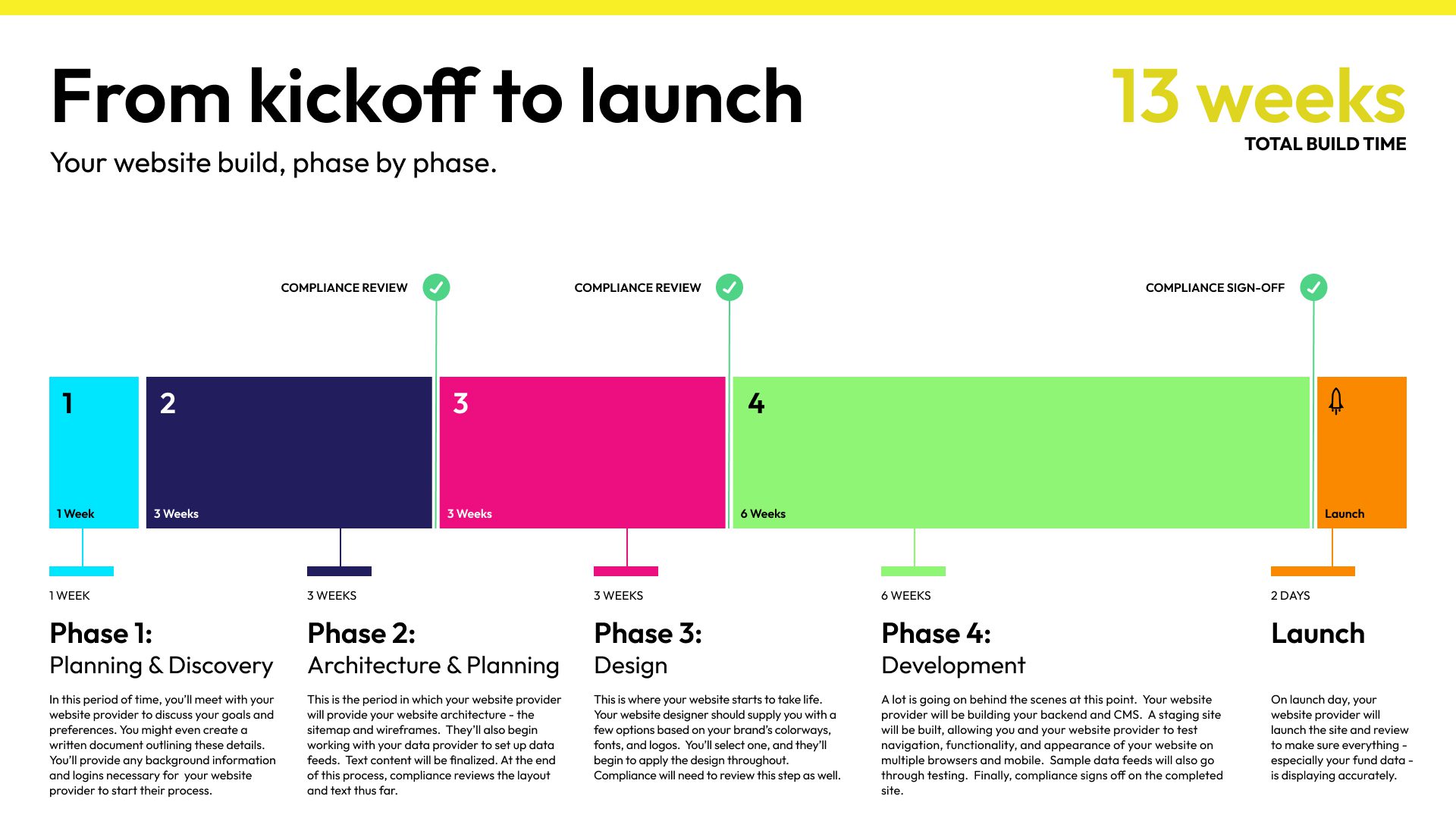
This timeline is for illustrative purposes only and may vary depending on client and compliance requirements.